A browser-based AI co-writing studio for novelists

You direct. The AI drafts.
Nothing becomes canon without your approval.

Tindra turns a premise into a finished, voice-consistent novel — one approved beat at a time. It runs in your browser, is screen-reader-first, and encrypts every word end-to-end on your own device, for writers who refuse to let the machine take the wheel.

Runs in any modern browser — install it like an app. Your manuscript is end-to-end encrypted on-device and synced across your devices over servers that hold only ciphertext we cannot read.

  • End-to-end encrypted
  • Screen-reader-first
  • Bring your own AI key
  • KDP-ready exports
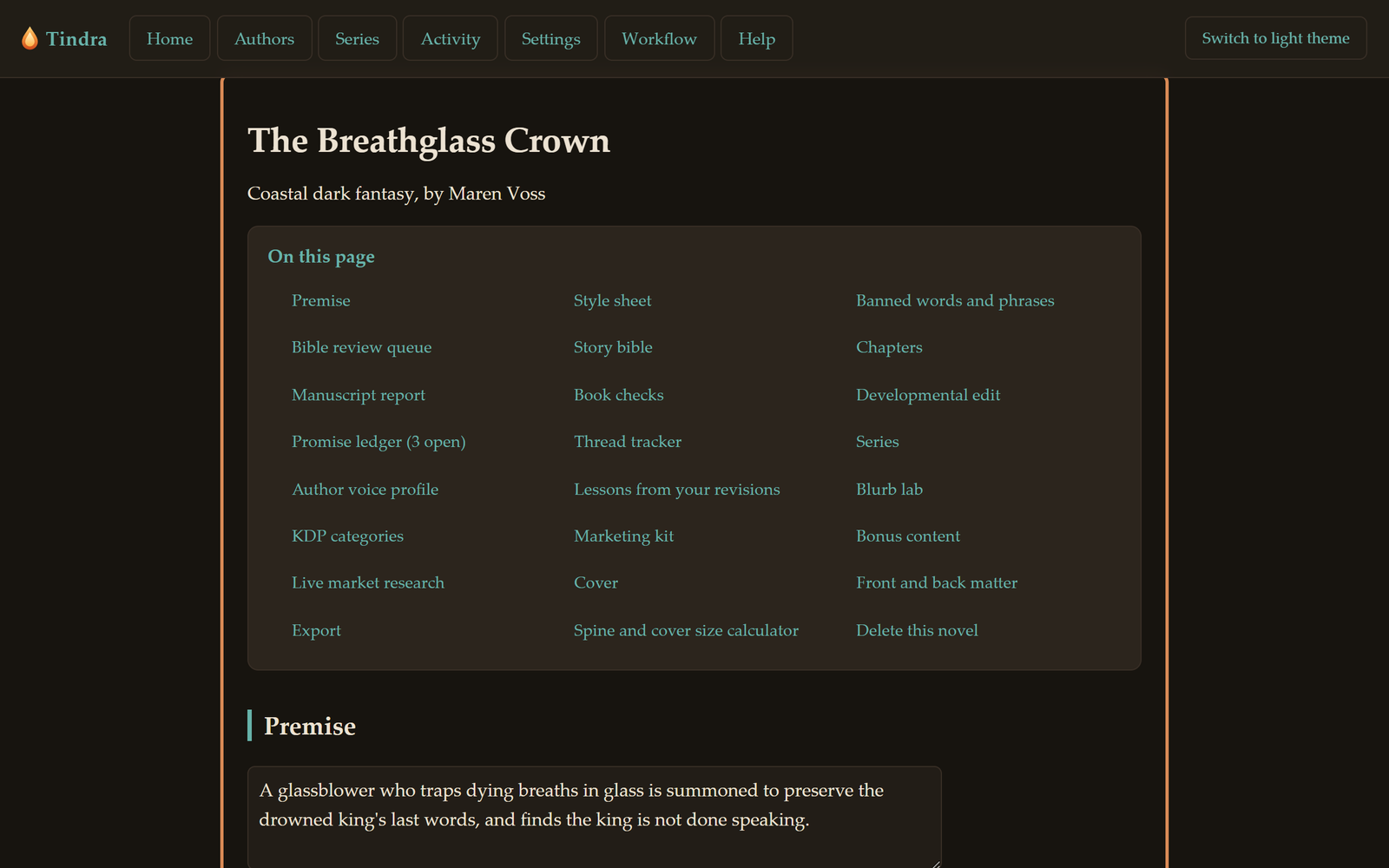
The Tindra studio open on a novel called The Breathglass Crown, showing section tabs for the story arc, story bible, threads and promises, causal logic, cover studio, and whole-book craft, above the book's premise and a whole-book Manuscript atlas.

A pipeline with you at every gate

Every stage is a proposal. You review, revise, or reject before anything moves forward. Nothing the AI drafts becomes canon until you accept it.

  1. Premise to outline

    Give Tindra a single idea and it proposes a story arc and a chapter outline. You reshape the structure until it's yours before a beat is planned.

  2. Chapters to beats

    Each chapter breaks into 6–10 beats. You write or approve a scene brief for each — the emotional shift it must earn, what's hidden and from whom — before a sentence of prose exists.

  3. Beats to prose

    Beats are drafted one at a time, written to a firm word target, linted against your banned-words list before you ever read them, and revised until you mark them approved.

What Tindra does

Six things that set it apart. There's a lot more under each — see the full list when you're ready.

Write with you at the wheel

Draft each beat from a scene brief that fixes the subtext first, run three competing drafts and combine the best, and steer every line. Never a "write my novel" button — always a draft you accept or send back, with full version history.

An AI editorial board, not a generate button

Specialist editors flag the exact lines that read machine-written; a surgical editor repairs only those and leaves the rest of your prose word for word. Backed by a free quality scorecard and an honest beta-reader panel.

A story bible that knows what the reader knows

Facts are stamped to the chapter they become true, so the AI never knows more than the reader. Character arcs, threads, promises, and a converging continuity check keep a long book consistent with itself.

From manuscript to storefront

KDP-ready EPUB and .docx, print interiors and boxed sets, covers with an art-director chat, blurbs, keywords, live market research, and the full Amazon A+ Content page — all in one studio.

Private by architecture

Your work is end-to-end encrypted on your device and synced across your devices over servers that hold only ciphertext we can't read. Bring your own OpenRouter key and pay AI providers directly, at cost.

Screen-reader-first, not screen-reader-compatible

Built by and for a blind novelist who works in JAWS every day: real headings, full Alt+key control, every result announced, and every cover and generated image described in honest words.

See all features

See it in action

A real project inside Tindra — the same studio you'll write in. Each screen is fully operable by keyboard and screen reader; the captions describe what's shown.

The Tindra studio open on the novel The Breathglass Crown. A row of section tabs reads Book details, Story arc, Story bible, Threads and promises, Causal logic, Cover studio, and Whole-book craft. Below the title sits the book's premise and the start of the Manuscript atlas — a whole-book view that sizes and shades each chapter by how far along it is.
Your whole book in one place Chapters, the story bible, threads, covers, and KDP exports — all from the novel's home screen.
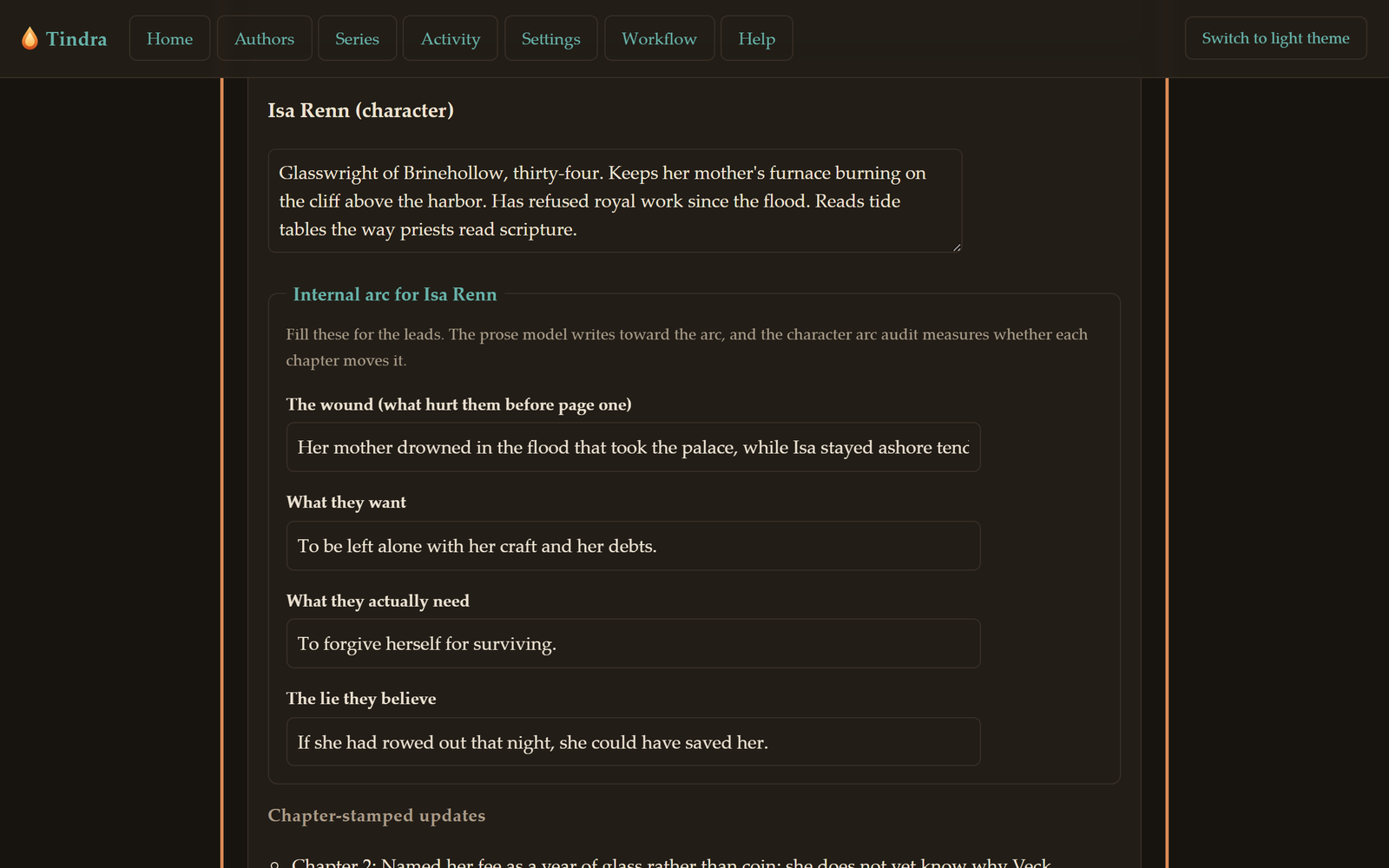
The story bible's Characters section for the same novel. Two entries are shown — Isa and Halvard — each with a paragraph of facts followed by a four-part internal arc set out as Wound, Want, Need, and The lie, every part a single sentence. Isa's lie reads 'Caring is just a longer way to grieve.'
A bible that tracks each character's arc Wound, want, need, and the lie they believe — so the AI writes them changing, not standing still. Facts are stamped to the chapter they become true.
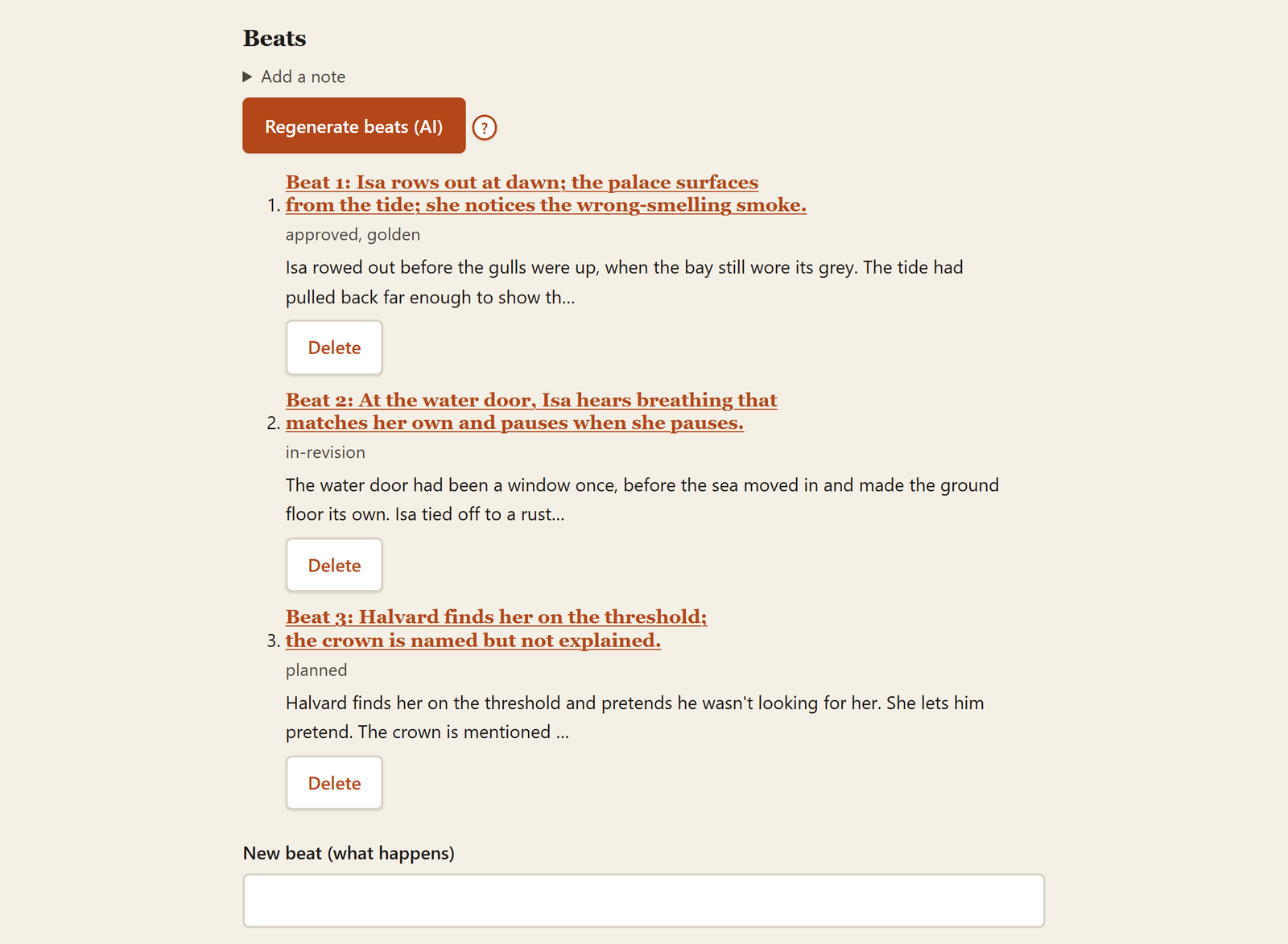
A chapter's Beats list. Three beats each show a status: beat 1 is approved and golden, beat 2 is in-revision, beat 3 is planned. The opening line of each beat's prose is previewed beneath its description.
Every beat, with its status Plan, revise, and approve beats one at a time. Nothing becomes canon until you mark it so.
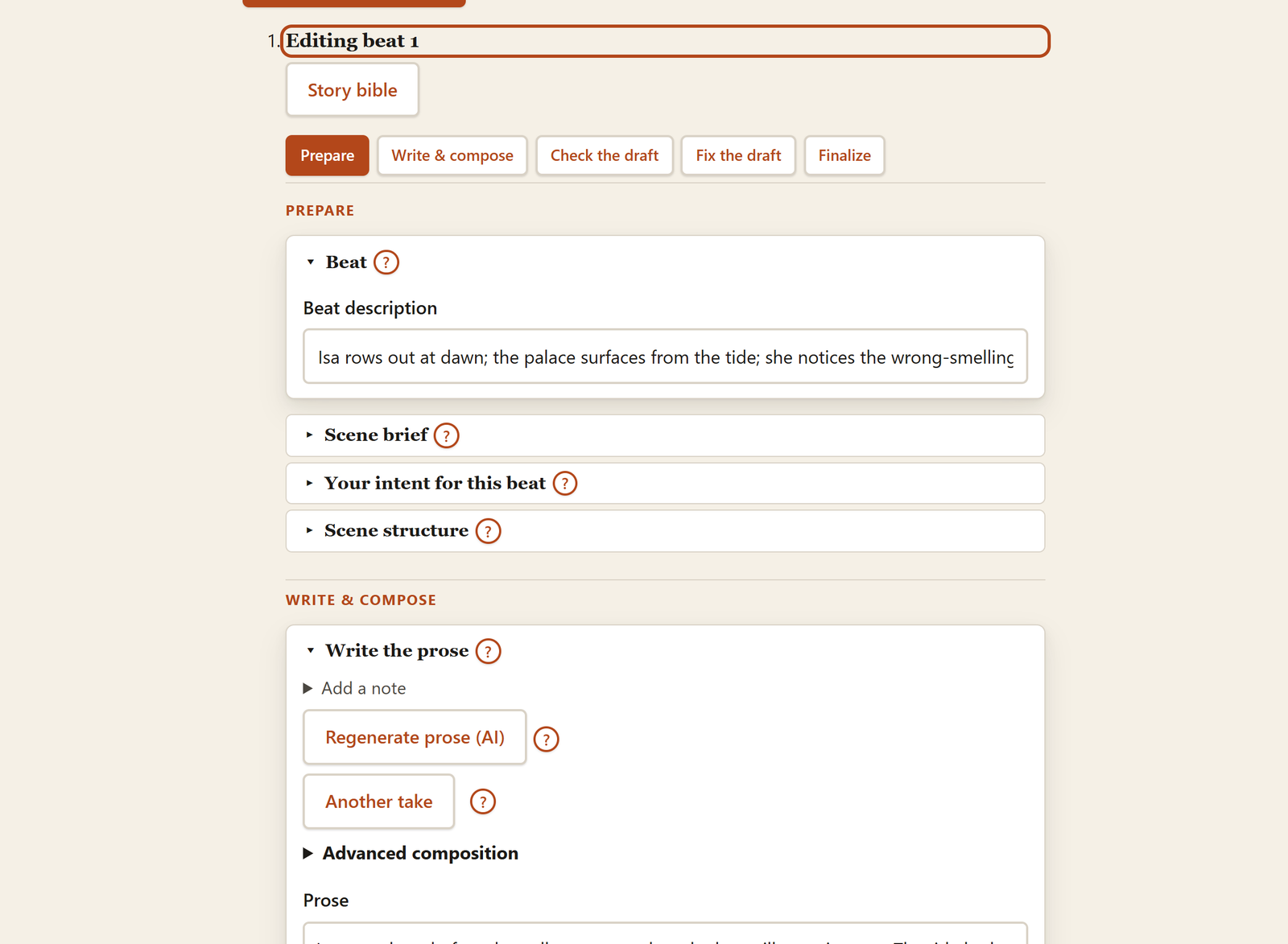
The beat editor open on beat 1. A row of phase tabs reads Prepare, Write & compose, Check the draft, Fix the draft, and Finalize, with Prepare selected. Below it, stacked cards titled Beat, Scene brief, Your intent for this beat, and Scene structure — the Beat card showing the description 'Isa rows out at dawn; the palace surfaces from the tide; she notices the wrong-smelling smoke.' Further down, the Write the prose card holds Regenerate prose and Another take buttons above the drafted prose.
An editor you steer card by card Work a beat in phases — prepare, write, check, fix, finalize — generating, taking another pass, or running three drafts and combining. Always a draft you accept or send back, never an auto-applied rewrite.

Built for writers who use a screen reader

Tindra wasn't made accessible after the fact — it was built by a blind author as a tool he could actually use to write and publish his own novels. Real semantic headings to jump by, full keyboard control, every action and result spoken aloud, and even cover art and marketing images described in rich, honest words so you can direct visual work you can't see. If you write with a screen reader, this was made for you. If you don't, everything still works beautifully by keyboard.

See the accessibility features →

What it feels like to write here

You hand Tindra an idea and it comes back with a shape — an arc, a chapter list — that you bend until it's yours. You sketch a beat: the secret she's keeping, the temperature in the room, the one truth that must stay unspoken. The draft arrives already linted against the words you've banned, written to length, honest to your point of view.

You don't read it and despair. You convene the board. The subtext editor quotes the line that tells instead of shows; the literary editor names the sentence a sharp reader would clock as machine-made. You repair only those spans — the rest stays word for word — and the bible quietly absorbs the new scar she carries, stamped to this chapter so it never leaks into the last one.

Nothing happened that you didn't approve. The book drifts toward your voice, not away from it — and when it's done, the same studio builds the cover, writes the blurb, and exports the KDP-ready file you upload. You direct. The AI drafts. You decide what's true.
Your novel. Your voice. Your call.

Seven days free. Cancel in two clicks. Keep everything you write — in formats no one but you can read.

See pricing & start free